
Sanju Left Out, But Not Left in the Dark: Gambhir Made Sure He Heard It From Him
The India head coach Gautam Gambhir, recently revealed that he personally spoke to Sanju Samson when the wicketkeeper-batter was left out of the squad. Rather than allowing the decision to reach the player through a team sheet or a media report, Gambhir chose to have the conversation face to face.
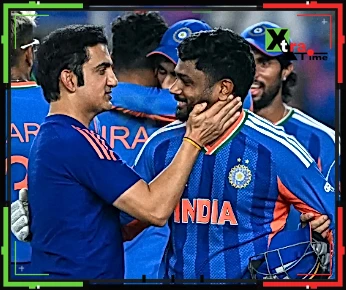
Xtratime Webdesk: In Indian cricket, selection calls can often become bigger stories than the matches themselves. But Gautam Gambhir believes the way those decisions are communicated matters just as much.
The India head coach Gautam Gambhir, recently revealed that he personally spoke to Sanju Samson when the wicketkeeper-batter was left out of the squad. Rather than allowing the decision to reach the player through a team sheet or a media report, Gambhir chose to have the conversation face to face.
“I told Sanju face to face,” Gambhir said, explaining how the difficult call was handled.
That one line offers a glimpse into the kind of dressing-room culture Gambhir wants to build one where players are given clarity, even when the message is not what they want to hear.
For a player, being dropped can be difficult to process. But direct communication can remove another layer of uncertainty. Instead of wondering why a decision was taken, the player hears it directly from the person responsible for the call. And this could become increasingly important as India manages a deep pool of talent.
Gambhir also pointed towards the performances and impact of the players involved while explaining India’s selection thinking. Sanju Samson finished the 2026 T20 World Cup with 321 runs at a strike rate of 199.37, while Abhishek Sharma has also been a key part of India’s attacking opening combination. Meanwhile, 15-year-old Vaibhav Sooryavanshi has impressed on his opportunities, scoring 151 runs in Zimbabwe at a strike rate of 196.10. But numbers alone do not explain every selection call. In such an environment, communication becomes a major part of team management.
Gambhir’s approach suggests that difficult conversations are not necessarily being avoided. They are being handled directly. The Sanju Samson episode, therefore, is bigger than one player missing out.
It raises a broader question about how India’s dressing room is being managed under Gambhir, where selection may be ruthless, but the conversation behind the selection is expected to be personal and transparent. For Indian cricket, that could be an important part of the culture Gambhir is trying to establish.